




Blogs
RAM Price Increase 2026: How Soaring Memory Costs Are Impacting the Refurbished PC Market

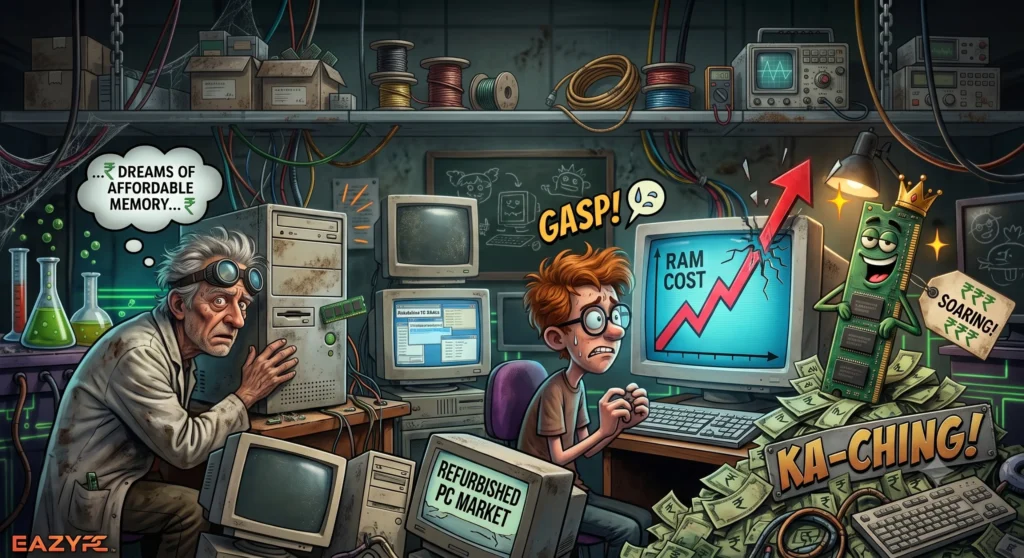
What started as a "memory shortage" story in mid-2025 has turned into one of the strangest hardware markets in years, and it's changing how Indian buyers think about PCs altogether.
RAM and SSD prices have risen sharply since mid-2025 because memory makers are diverting DRAM and NAND capacity to AI data centers. Here is the short version for anyone buying a PC in India in 2026.
What changed: DRAM contract prices rose 90–98% in Q1 2026 and 58–63% in Q2, easing to 15–18% growth in Q3. Laptop RAM kits are up roughly 4–5x and NVMe SSDs 60–70% since early 2025, with real relief unlikely before 2027.
Why: Samsung, SK Hynix and Micron have shifted fab capacity to high-margin AI server memory, squeezing supply of consumer RAM and SSDs.
What to do: Refurbished laptops are the least affected category because their memory was sourced before the spike. Buy the RAM and SSD configuration you need up front, from refurbishers offering a 6-month or longer warranty.
If you've priced out a laptop, a RAM upgrade, or even a new SSD lately, you already know something's off. What started as a "memory shortage" story in mid-2025 has turned into one of the strangest hardware markets in years, and it's changing how Indian buyers, refurbishers, and IT resellers think about PCs altogether.
At EazyPC, we deal with this daily. Corporate quotes that were valid last week aren't valid this week. Configurations that used to be our "safe" budget choices now sit closer to mid-range pricing. Here's an honest, updated look at what's actually happening with RAM and SSD prices in 2026, why it's happening, and, more usefully, what it means for anyone buying a refurbished laptop or desktop right now.
How We Got Here: A Quick Timeline
RAM and SSD pricing was stable. A 16GB DDR4 module could be picked up for roughly ₹1,600, and a 256GB NVMe SSD hovered around ₹1,400.
Prices started climbing steadily. By October, the same 256GB NVMe drives had crossed ₹2,350, a jump of nearly 70% in six months.
This is where things went from "rising" to "alarming." Industry analyst TrendForce reported conventional DRAM contract prices jumping somewhere between 90–98% quarter-on-quarter, the sharpest quarterly increase on record. Some PC-grade DRAM categories tracked over 100% QoQ.
Rather than cooling off, another 58–63% quarter-on-quarter increase followed. DDR4, which many buyers assumed was a "safe," older technology, was hit almost as hard as DDR5; some tracked kits effectively doubled or tripled within a matter of months.
The first real sign of a slowdown. TrendForce's Q3 data showed DRAM contract prices rising "only" 15–18% quarter-on-quarter, still an increase, but a clear deceleration from the 90%+ spikes earlier in the year.
So no, this isn't a one-time price bump that will correct itself in a few weeks. It's a structural shift that's now roughly 15 months old, and every recent forecast suggests it isn't finished yet.
Why Is This Happening?
AI training clusters and inference servers run on enormous pools of DRAM and high-bandwidth memory (HBM) to keep GPUs fed. Samsung, SK Hynix, and Micron, the three companies that make almost all the world's DRAM, have been redirecting fab capacity toward these high-margin server and HBM products, leaving less room for the consumer-grade RAM and SSDs that go into everyday laptops and desktops.
A few numbers put this in perspective:
Micron's HBM and cloud-related memory revenue grew from around 17% of its total DRAM revenue in 2023 to nearly 50% by 2025, and that share keeps growing.
SK Hynix's chairman has publicly suggested the memory shortage could persist through 2030, while Micron expects meaningful new supply capacity only from 2027–2028 onward.
On the NAND (SSD) side, TrendForce expects the market to stay undersupplied by roughly 4–6% for the rest of 2026, with real relief not expected until the second half of 2027.
In simple terms: DRAM makers are choosing to sell chips to AI data centers over PC and laptop manufacturers, because that's where the money is. Everyone downstream (OEMs, system integrators, refurbishers, and eventually the end customer) absorbs the squeeze.
The Climb, Visualized
DRAM contract price index vs. average 32GB DDR4 kit retail price (₹), Q3 2025 → Q3 2026
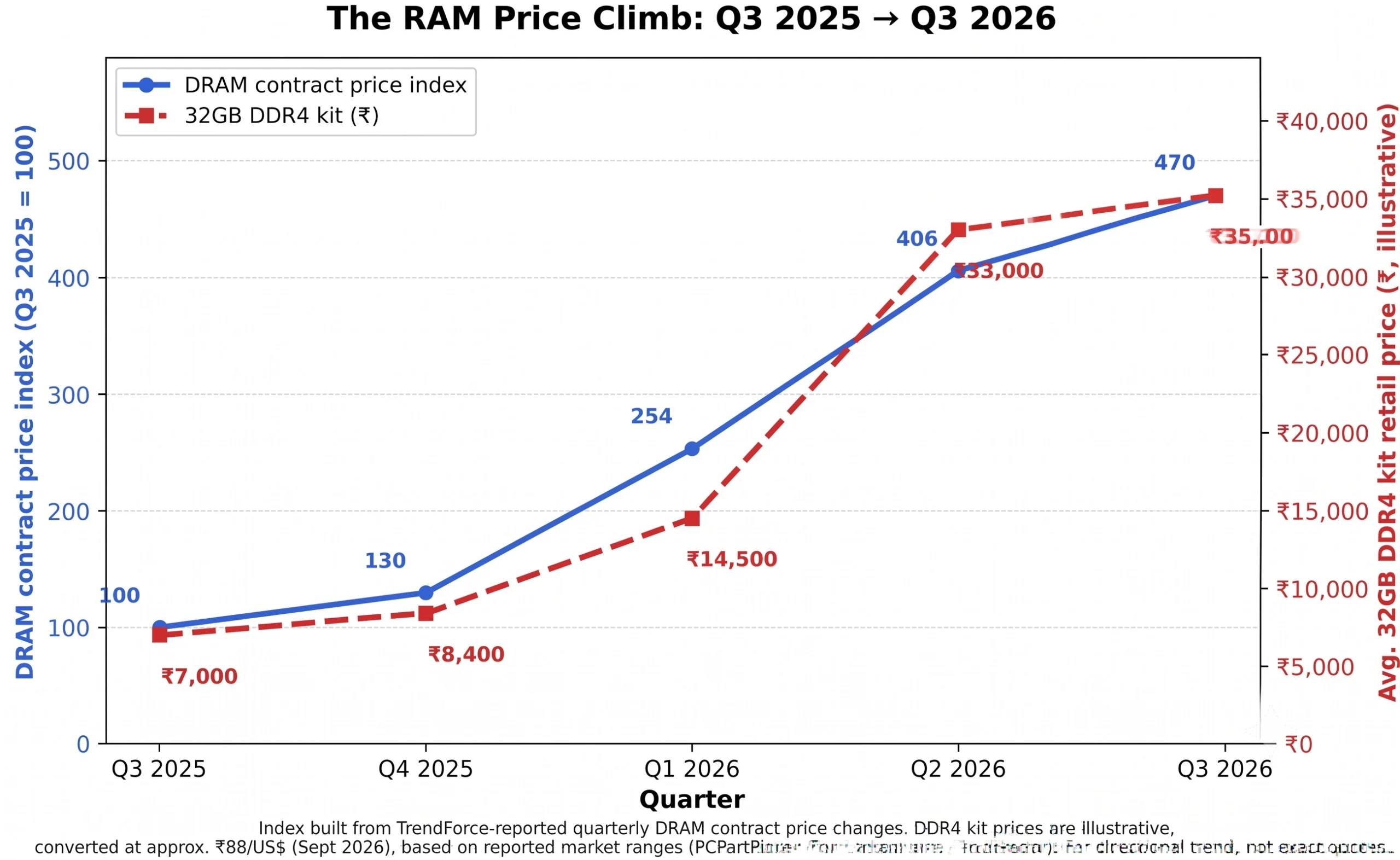
Both lines tell the same story from two different angles: one tracks what memory makers charge each other under contract, the other tracks what a shopper actually pays at retail, and they move almost in lockstep. The steepest single jump happened in Q1 2026, and while Q3 2026 shows the rate of increase finally slowing, prices themselves are still climbing, not falling.
It's Not Just RAM: What Else Got More Expensive
Here's the part that surprises a lot of people: this isn't really a "RAM story" anymore. DRAM and NAND sit inside far more products than laptops, and the price shock has rippled outward through 2026 into almost every category of consumer electronics.
| Product Category | What's Happened | Approx. Increase (2025–2026) | Why |
|---|---|---|---|
| Laptop/PC RAM (DDR4/DDR5) | Kits that cost ₹6,000–8,000 in late 2025 now regularly sell for ₹31,000–36,000+ | 4-5x | Fabs prioritizing AI server DRAM over consumer modules |
| Graphics cards (GPUs) | Nvidia has reportedly raised GPU bundle prices three times in 2026 (up to 20–30% each round); AMD flagged a further 10–15% Radeon hike for Q3 2026 | GDDR6: ~₹220/GB → ~₹670/GB | GPUs are sold bundled with VRAM, and GDDR6/GDDR7 share the same production lines as DRAM |
| Smartphones (flagship) | Memory now accounts for over 20% of a smartphone's total manufacturing cost, versus 10–15% before; some brands have already raised MSRPs | BOM up ~25% | LPDDR RAM and mobile NAND are squeezed by the same AI-driven demand |
| Gaming consoles & hardware | Console and gaming hardware pricing rose an estimated 16% globally through 2026, with Indian retail prices following | DDR5 ~3x | Same memory suppliers (Samsung, SK Hynix, Micron) serve consoles, GPUs, and AI servers alike |
| SSDs / storage | 256GB and 512GB NVMe drives have both climbed sharply, with the gap between them narrowing | ~60–70%+ | NAND flash supply deficit expected to persist through 2026, easing only in H2 2027 |
| Refurbished/used laptops (India) | Price stability has held up far better than new hardware, since memory was sourced before the sharpest hikes | Comparatively minimal | Refurbishers resell already-installed components rather than buying fresh memory at today's prices |
The pattern is consistent everywhere: any device that depends on DRAM, GDDR, or NAND is now more expensive to build, and manufacturers are passing that along. Refurbished hardware is the one category in this table that's been largely insulated from the shock, which is exactly why it's worth a closer look right now.
When Will Prices Normalize?
Nobody is promising quick relief, but here's the realistic outlook based on current analyst forecasts:
| Scenario | Probability (approx.) | Timeline |
|---|---|---|
| Best case | 20% | Relief begins Q3 2026, meaningful normalization by Q4 2026 |
| Base case | 60% | Gradual price declines from Q3 2026 through Q1–Q2 2027 |
| Worst case | 20% | Prices stay elevated into late 2027 or even 2028 |
The Q3 2026 slowdown to 15–18% QoQ growth (versus 90%+ earlier in the year) is a mildly encouraging sign that the worst of the rate of increase may be behind us. But "normalizing" doesn't mean prices fall back to 2024 levels; it mostly means the market stops swinging wildly and settles into more predictable, if still elevated, pricing.
📖 Understanding When to Upgrade RAM or SSD on Your Refurbished Laptop? →What This Means for the Refurbished PC Market
This is where it gets directly relevant if you're shopping for a laptop today.
1. Refurbished machines are becoming relatively more attractive, not less
New laptops bake current RAM and SSD costs directly into their sticker price. A refurbished laptop, on the other hand, typically already comes with its memory and storage installed, sourced and priced before this latest wave of increases, or absorbed by the refurbishers rather than passed on unit-by-unit. That gap in value has widened through 2026.
2. The configuration mix has shifted toward what's already fitted
According to refurbished market data from August 2026, over half of Indian buyers are currently choosing budget configurations (largely 6th–7th generation Intel Core i3/i5 machines with 4GB RAM), while mid-range buyers (8th–10th gen i5, 8GB RAM) and premium buyers (i7 or higher-end i5 with 16GB+) make up the rest. Lenovo has pulled ahead as the most popular refurbished brand in India, with models like the ThinkPad L490 (i5, 8th Gen) and Dell Latitude 3400 (i5, 8th Gen) topping demand, followed by HP's ProBook line and Dell's Latitude series.
3. Popular value picks right now
Approximate street pricing, certified condition with warranty:
Lenovo ThinkPad T480 (i5, 8th Gen, 8–16GB RAM): a long-running favorite for its keyboard and durability, generally ₹21,000–₹34,000 depending on RAM/SSD.
Dell Latitude 5410/5420 (i5, 10th/11th Gen): a step up in performance, typically ₹26,000–₹49,000.
HP EliteBook 840 G5 (i5, 8th Gen, 8–16GB RAM): a solid mid-range business option in a similar band.
4. Quotations and turnaround times are less stable
Refurbishers (us included) are finding it harder to hold a quoted price for long, especially on higher-RAM configurations, because our own component sourcing costs can shift within days. If you're negotiating a bulk/corporate order, expect more urgency around locking in pricing quickly.
Why Refurbished Is a Genuinely Good Buy Right Now
It's worth being direct about this: refurbished isn't just "the cheaper option" this year; it's arguably the smart option, for a few concrete reasons tied directly to everything above.
- The memory is already installed, at yesterday's prices. A refurbished laptop's RAM and SSD were sourced, tested, and fitted before this latest wave of price hikes. You're not paying today's inflated component cost baked into a new-laptop price tag; you're buying a machine where that cost was already absorbed earlier in the supply chain.
- New-laptop prices are rising to cover exactly the costs refurbished buyers skip. As the comparison table above shows, OEMs across categories (phones, GPUs, consoles, and laptops) are actively raising prices to offset memory costs. That gap between "new" and "refurbished" pricing has genuinely widened in 2026, not narrowed.
- You still get business-grade durability. Most certified refurbished stock in India is enterprise-grade (ThinkPads, Latitudes, EliteBooks) built for corporate fleets and designed to be serviced and last, not consumer laptops built down to a price.
- Warranty coverage removes the biggest risk. A 6-month (or longer) warranty on a certified refurbished unit means you're not exposed to today's repair or replacement costs if something goes wrong; the seller absorbs that risk, not you.
- It's a genuinely lower environmental footprint, extending a working machine's life instead of demanding fresh silicon at a time when fresh silicon has never been more resource-constrained.
In short: while the rest of the market scrambles to reprice around expensive memory, refurbished buyers are largely sitting outside that scramble. That's not a marketing line; it's just how the supply chain currently works.
Best Value Picks from EazyPC Right Now
A few certified refurbished options currently offering strong value, given everything above:
All of these ship with EazyPC's standard 6-month warranty, so the RAM and storage you're getting are protected even while component markets outside stay volatile.
Practical Tips for Buying Smart Right Now
- Buy the RAM configuration you actually need, built in; don't plan to upgrade later. Standalone RAM module prices have risen far faster than pre-installed configurations in refurbished machines. If there's a decent chance you'll need 16GB down the line, it's often cheaper to buy that spec now than to buy an 8GB machine and add a module in six months.
- Don't assume DDR3 or DDR4 machines are the "cheap" option anymore. DDR4 pricing has risen almost as sharply as DDR5 in 2026, and DDR3 (still found in some very old refurbished units) isn't immune either. Check current module pricing for the specific RAM type before assuming an older laptop saves you money on future upgrades.
- Prioritize dual-channel, upgradable RAM slots over soldered memory when you can. Once prices do ease, even partially, from 2027 onward, laptops with accessible RAM slots let you upgrade cheaply later. Soldered-memory ultrabooks lock you into whatever configuration you buy today.
- Weigh SSD capacity carefully. With NAND supply staying tight through 2027, the price gap between 256GB and 512GB isn't as wide as it used to be relative to the base laptop price. It's often worth stretching for the larger drive now rather than trying to add storage later.
- Buy from certified refurbishers with a documented warranty. In a volatile component market, warranty coverage (ideally 6 months or more) protects you from being stuck footing today's inflated repair or replacement costs if RAM or storage fails.
- If you're a business or bulk buyer, lock in quotes fast. Component costs for resellers can move within days right now. If you're comparing refurbishers, ask how long a quoted price is actually valid for before committing.
- Keep an eye on quarterly forecasts if your purchase isn't urgent. The deceleration seen in Q3 2026 (15–18% QoQ vs. 90%+ earlier in the year) suggests the sharpest phase of this cycle may be easing, even if full normalization is still a year or more away. If you can wait a purchase out by a quarter or two without real cost to you, it may be worth watching the trend rather than buying at the peak.
The Bottom Line
The Bottom Line
The RAM and SSD price surge that started in 2025 isn't a blip; it's the direct result of AI infrastructure permanently reshaping how global memory supply gets allocated. Analyst consensus now points to gradual, not sudden, relief, with most forecasts converging on 2027 as the earliest realistic year for real normalization, and NAND/SSD possibly staying tight even longer.
For everyday buyers, refurbishers, and IT resellers in India, that means treating current memory pricing as the new normal for the near future, and buying accordingly: choose the RAM/SSD configuration you actually need up front, buy from a source that stands behind its warranty, and don't assume "cheap now, upgrade later" still holds the way it used to.
Frequently Asked Questions
RAM prices are high in 2026 because Samsung, SK Hynix and Micron have redirected DRAM production capacity toward high-margin AI server memory and HBM, leaving less supply for consumer modules. DRAM contract prices rose 90–98% in Q1 2026 and a further 58–63% in Q2 2026.
Most analyst forecasts expect gradual relief rather than a sharp drop. The base case, at roughly 60% probability, is declining prices from Q3 2026 through Q1–Q2 2027. NAND and SSD supply is expected to stay tight into the second half of 2027, and a return to 2024 price levels is not expected.
Laptop RAM kits are up roughly 4–5x since late 2025. Kits that sold for ₹6,000–8,000 in late 2025 now regularly sell for ₹31,000–36,000 or more. NVMe SSDs have risen around 60–70% over the same period.
Yes, for most buyers refurbished offers better value in 2026. Refurbished laptops already have their RAM and SSD installed at pre-spike prices, so buyers avoid the component cost increases baked into new-laptop pricing. Certified refurbished business laptops in India currently sell for roughly ₹21,000–₹36,000 with warranty.
No. Standalone RAM modules have risen far faster than pre-installed configurations in refurbished machines. If you are likely to need 16GB, it is usually cheaper to buy that configuration now than to add a module in six months.
Not meaningfully. DDR4 pricing rose almost as sharply as DDR5 through 2026, and some DDR4 kits doubled or tripled within months. Older DDR3 modules have also increased. Check current pricing for the specific memory type before assuming an older laptop is cheaper to upgrade.
Enterprise-grade business models offer the strongest value. The Lenovo ThinkPad T480 runs about ₹21,000–₹34,000, the Dell Latitude 5410/5420 about ₹26,000–₹49,000, and the HP EliteBook 840 G5 sits in a similar mid-range band. All are built for corporate fleets and are designed to be serviced.
Estimates vary. SK Hynix's chairman has suggested the shortage could persist through 2030, while Micron expects meaningful new capacity only from 2027–2028 onward. The most common forecast points to 2027 as the earliest realistic year for normalization.


