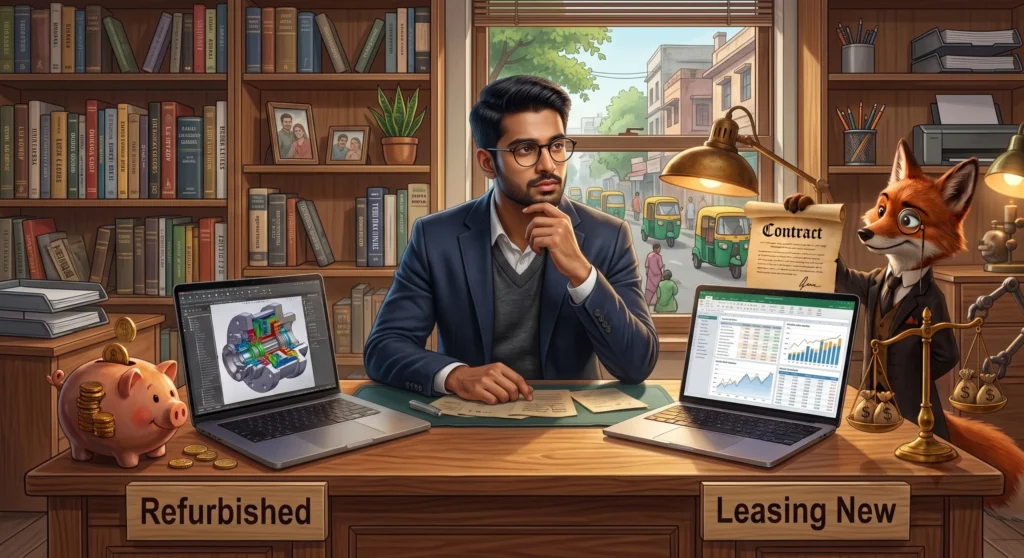
Leasing New Laptops vs Buying Refurbished: The Real 3-Year Cost Comparison for Businesses
Businesses equipping a team typically consider two paths: lease new laptops through a vendor financing plan, or buy refurbished commercial-grade laptops outright. Both solve the cash-flow problem differently. This comparison looks at total cost of ownership over a realistic 3-year deployment window, not just the monthly numbers.
The Comparison
| FACTOR |
LEASING NEW |
BUYING REFURBISHED |
| Upfront cost |
Low; spread across the lease term |
Low-to-moderate, one-time or EMI |
| Total 3-year cost |
Often highest, includes lease markup/interest |
Typically the lowest total outlay |
| Asset ownership |
None; laptops are returned at lease end |
Full ownership from day one |
| Hardware tier for the budget |
Entry-to-mid consumer specs |
Commercial-grade, often better specs for equivalent spend |
| Flexibility to resell/repurpose |
Not applicable, leased |
Full flexibility, can resell or reassign |
| Ongoing support |
Vendor-managed; often bundled |
Warranty-backed, vendor-dependent |
See more: The Ultimate Guide to Buying the Best Laptop Under ₹35,000 (2026) →
Customization and IT Control
When you buy refurbished laptops outright, your IT department has full control. If an employee needs more RAM or a larger SSD a year into their employment, IT can open the machine and upgrade it. With leased hardware, opening the chassis often voids the warranty or breaches the lease contract, forcing you to lease an entirely new, more expensive machine just to get a minor spec bump.
The Sustainability Factor (ESG)
For modern businesses, e-waste is a growing concern. Extending the life of an existing commercial laptop by buying refurbished drastically reduces your company's carbon footprint. It requires zero new mining for rare earth metals and prevents functional hardware from ending up in landfills, which is a powerful addition to your company's Environmental, Social, and Governance (ESG) reporting.
When Leasing Still Makes Sense
- Your business wants to guarantee access to the newest hardware generation on a fixed refresh cycle
- Bundled managed IT support is a priority over lowest total cost
When Buying Refurbished Wins
- Minimizing total 3-year cost is the primary goal
- Your team's workload doesn't require the newest hardware generation
Worth knowing: A refurbished commercial laptop bought outright and used for 3–4 years often costs less per year of use than a new laptop lease, even before accounting for resale value at the end of its life.
See our full Refurbished vs New comparison →
Frequently Asked Questions
Q. Can refurbished laptops be included in company asset depreciation schedules?
Yes, refurbished laptops are typically treated the same as any other owned business asset for depreciation purposes; however, you should confirm specifics with your accountant.
Q. Is leasing better for very large enterprises?
Large enterprises may prefer leasing for standardized refresh cycles and bundled support, though cost-conscious teams increasingly mix both strategies.
Q. What happens to refurbished laptops at the end of life for a business?
Since the business owns the hardware, it can be resold, redeployed to a lower-priority role, or responsibly recycled — options not available under a lease.